5 Common Sourdough Mistakes (and How to Fix Them)
📖 12 min read | Updated July 2026
By SourdoughCalc Team
Every sourdough baker has pulled a loaf out of the oven that was flat, dense, gummy, or just plain disappointing. The good news: most sourdough problems come from the same five mistakes, and they are all fixable. This guide walks you through what went wrong, why it happened, and exactly how to fix it next time.
New to sourdough? Read our complete beginner's guide to hydration first, or jump to our 10 best hydration calculators.
Mistake #1: Your Dough Is Under-fermented
What it looks like: a dense, tight crumb that does not have visible holes. The loaf often tears unevenly when you cut it. It may also taste sour but feel heavy in your mouth.
Why it happens: you pulled the dough out of bulk fermentation too early. The yeast had not finished producing gas, so the crumb did not have time to open up.
How to fix it:
- Add 30–60 minutes to your bulk fermentation time and re-evaluate
- Look for visual cues, not just time: the dough should be 50–75% larger, jiggle when you shake the bowl, and have bubbles around the edges
- Do the windowpane test before shaping: a small piece of dough should stretch thin enough to see light through without tearing
- If your kitchen is cold (under 70°F), plan for 1–2 hours longer than the recipe says
Mistake #2: You Cut Into the Loaf Too Early
What it looks like: the inside of the loaf is gummy and dense, even though the crust looks great. It feels "under-baked" in the middle.
Why it happens: sourdough is not actually done baking when it comes out of the oven. The interior is still setting. Cutting into it too early traps moisture and leaves you with a gummy crumb that will not slice cleanly.
How to fix it:
- Wait at least 1 hour before cutting. Ideally 2 hours.
- The internal temperature should drop to around 90°F (use an instant-read thermometer)
- If you can smell a strong yeasty or sour smell when you cut, the crumb is still gummy
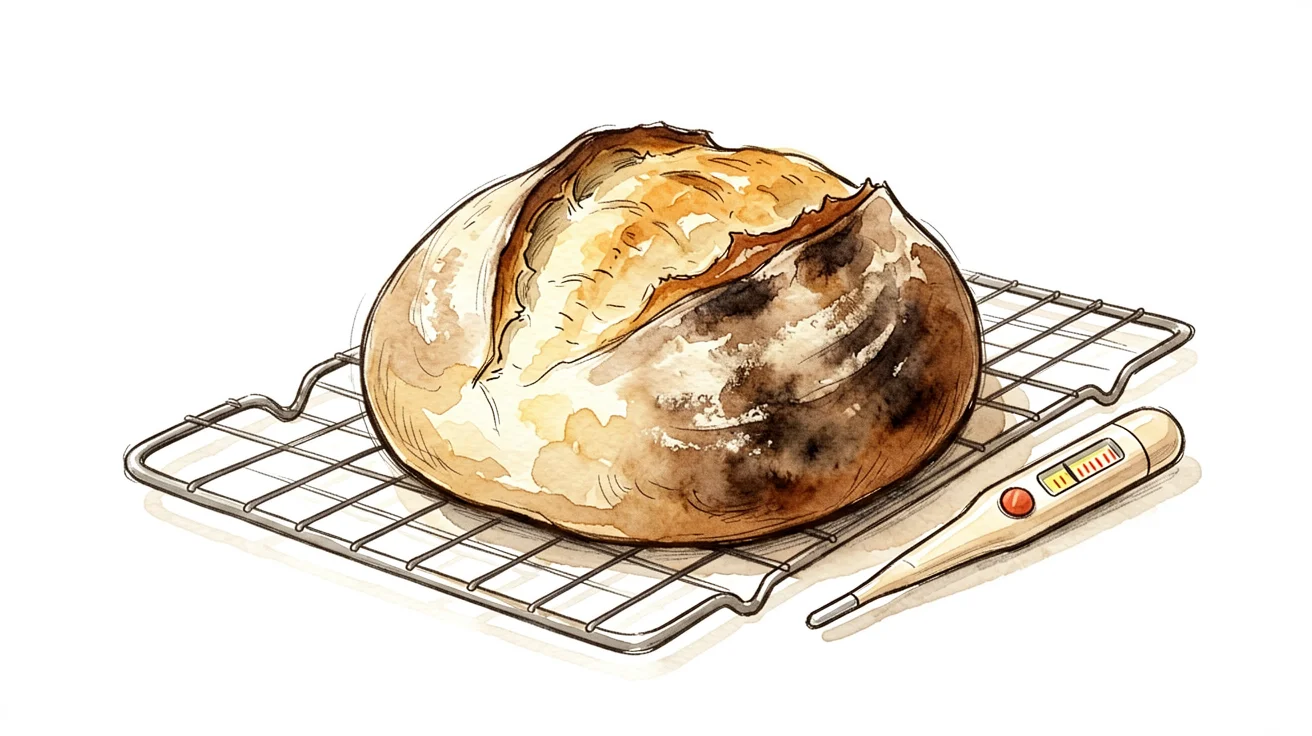
- Resting on a wire rack (not a cutting board) helps air circulate and the crust stay crispy
Mistake #3: Your Hydration Is Too High for Your Flour
What it looks like: the dough spreads out flat during shaping instead of holding a round shape. The final loaf is wide, flat, and has a dense bottom crust.
Why it happens: you are using high hydration (80%+) with flour that cannot support it. Weak or all-purpose flour breaks down under high hydration, leaving you with a slack dough that collapses under its own weight.
How to fix it:
- Check the protein content of your flour. Bread flour should be 12–14% protein. Anything below 11% will struggle at 80%+ hydration.
- If using all-purpose flour, stay at 70–75% hydration
- Strengthen your dough with a few stretch and folds during bulk fermentation
- Use a higher-protein flour like King Arthur Bread Flour or Bob's Red Mill Artisan Bread Flour
Our hydration guide has more detail on choosing the right hydration for your flour.
Mistake #4: Your Oven Is Not Hot Enough
What it looks like: the loaf comes out pale instead of deeply caramelized. The crust is soft rather than crackly. The oven spring (initial rise in the oven) is minimal.
Why it happens: sourdough needs intense heat for the first 20 minutes of baking. The heat creates oven spring and sets the crust. Most home ovens struggle to maintain the 450–500°F your dough needs.
How to fix it:
- Preheat your oven (and Dutch oven if using one) for at least 45 minutes at 500°F
- Use an oven thermometer — most home ovens are 25°F off their stated temperature
- If you have a Dutch oven, use it. It traps steam and gives you bakery-quality crust.
- Add 1 cup of water to a tray at the bottom of the oven for the first 20 minutes to create steam
- Lower the temperature to 450°F after 20 minutes, remove the lid if using a Dutch oven, and bake for another 20–25 minutes
Need gear recommendations? Our homepage has affiliate links to the Dutch ovens and tools we recommend.
Mistake #5: You Are Not Scoring Deep Enough
What it looks like: the loaf does not have the classic "ear" (the raised flap where you cut). Instead, the cuts barely open, or the dough tears unpredictably.
Why it happens: scoring is not decoration. It is a controlled release for the gas inside the dough. If you do not cut deep enough, the gas finds the weakest point and bursts out randomly. That is why your crust tears in ugly places.
How to fix it:
- Score at a 30–45 degree angle, not straight down
- Cut 1/2 inch (1.25 cm) deep for smaller loaves, 3/4 inch (2 cm) for larger ones
- Use a sharp lame (a razor blade on a handle) or a very sharp knife
- One confident cut beats five timid ones. Hesitation causes jagged edges.
- Always score right before putting the dough in the oven, never earlier
Bonus: How to Save a Bad Bake
Sometimes nothing goes right. The crust is burnt, the crumb is dense, and the loaf is shaped like a flying saucer. Before you throw it out:
- Too dense? Slice it thin and make sourdough grilled cheese. Density becomes a feature, not a bug.
- Too sour? Toast it. Heat cuts the perceived sourness.
- Crust burnt? Cut off the burnt parts and use the inside for breadcrumbs or croutons.
- Over-proofed and flat? Cut it into cubes and bake as croutons or stuffing.
Almost no sourdough bake is a total loss. Even the failures are delicious if you know how to use them.
FAQ: Sourdough Troubleshooting
Why is my sourdough dense and heavy?
Almost always under-fermentation. The dough did not have enough time for the yeast to produce gas and open up the crumb. Extend your bulk fermentation by 30–60 minutes and try again.
Why does my sourdough spread out flat?
Your dough is too wet for your flour, or you over-proofed it. Lower hydration by 5% or switch to a higher-protein flour. Also make sure you shape tightly and use a banneton or bowl to support the dough during the final rise.
Why is my sourdough gummy in the middle?
You almost certainly cut it too early. The internal temperature of the loaf needs to drop to around 90°F before slicing. Wait at least 1–2 hours after baking.
Why is my sourdough pale, not golden brown?
Your oven is not hot enough, or you are not using a Dutch oven. Sourdough needs 450–500°F for proper caramelization. Preheat longer, use an oven thermometer, and consider investing in a Dutch oven.
Why does my sourdough taste too sour?
Either your starter is very mature (over 12 hours since feeding) or your bulk fermentation is too long. Try a younger starter or a shorter bulk to mellow the flavor.
The Takeaway
Most sourdough problems come down to timing, hydration, or oven temperature. Once you understand the three knobs, almost every other variable is just fine-tuning. Track what you do in each bake (hydration, time, temperature) and you will start seeing patterns within five or six bakes.
Need help with the math? Our free hydration calculator handles the calculations so you can focus on the baking. And if you want to understand every number, our beginner's guide to hydration walks through the science.