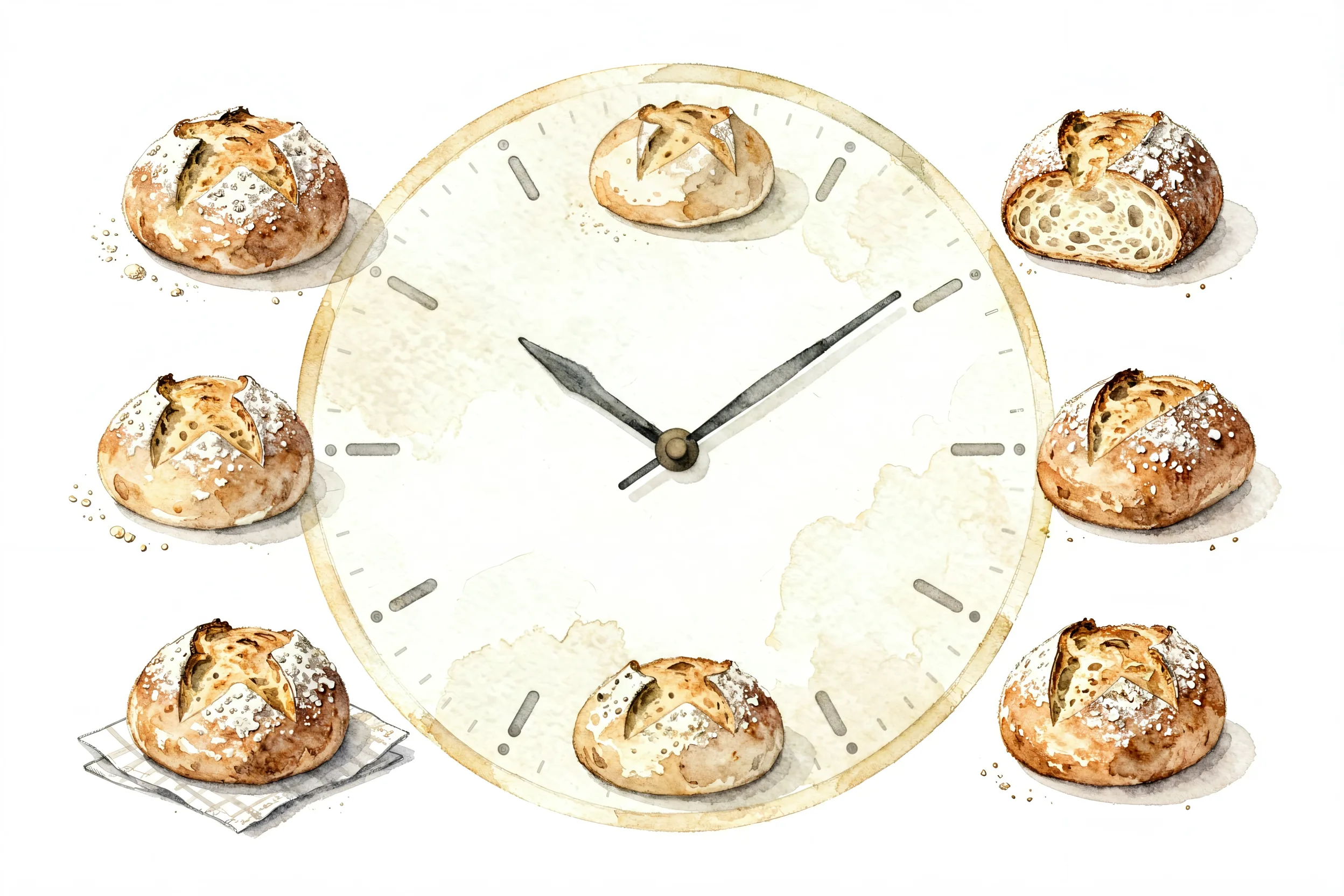
Sourdough Schedule: A 24-Hour Timeline for Your First Loaf
📖 9 min read · Updated July 2026
By SourdoughCalc Team
Most sourdough recipes give you ingredients but not a timeline. Here is the same recipe in a 24-hour clock: when to feed your starter, when to mix, when to stretch and fold, when to shape, when to bake. Follow this and you will have a loaf on the counter by tomorrow afternoon.
What Do You Need for This Sourdough Schedule?
- Kitchen at 70-74°F (21-23°C). Warmer kitchens shorten all times by 20-30%. Cooler kitchens extend them.
- Active, ripe starter (peaked in the last 4-8 hours).
- 500g flour total, 75% hydration, 20% ripe starter, 2% salt.
- Single 1kg loaf (about 800g baked weight).
What Should You Do the Night Before?
9:00 PM — Feed your starter
Take 10g of ripe starter, add 20g flour and 20g water. Stir, cover loosely, leave on the counter. By morning it should be doubled and domed, ready to bake with.
What Happens on Bake Day Morning?
8:00 AM — Autolyse (mix flour + water)
In a large bowl, mix 500g bread flour with 375g water (75%). Stir until no dry flour remains. The dough will be shaggy and stiff. Cover and let it rest for 30-45 minutes. During this autolyse, the flour fully hydrates and gluten begins to develop on its own.
8:45 AM — Add starter and salt
Add 100g of ripe starter and 10g salt. Pinch and squeeze to incorporate. The dough will loosen and become stickier. Cover and let rest.
9:15 AM, 9:45 AM, 10:15 AM, 10:45 AM — Stretch and folds
Every 30 minutes, do a stretch and fold. Wet your hand, grab one side of the dough, stretch it up until it resists, and fold it over itself. Rotate the bowl a quarter turn and repeat four times. After 4 sets, the dough will be noticeably smoother and more elastic.
When Is Bulk Fermentation Done?
11:00 AM - 2:00 PM — Bulk fermentation
Cover the dough and let it bulk for 3-5 hours at room temperature. Look for these signs of readiness, not just the clock:
- Dough is 50-75% larger than at the start
- Edges are domed and puffy, not flat
- Bubbles visible on the surface and sides
- Jiggles when you shake the bowl
Warmer kitchens (75°F+) finish in 3 hours. Cooler kitchens (68°F) take 5-6 hours. Don't go by time alone, go by feel.
How Do You Shape and Retard the Dough?
2:00 PM — Pre-shape
Tip the dough onto an unfloured counter. Using a bench scraper (or a large spatula), shape into a loose round. Let it rest 20-30 minutes, uncovered. This relaxes the gluten before final shaping.
2:30 PM — Final shape
Flip the dough, gently tighten into a boule (round) or batard (oval). Place seam-side up in a floured banneton or a bowl lined with a floured tea towel. Cover with a shower cap or beeswax wrap.
2:45 PM — Cold retard (optional but recommended)
Place the shaped dough in the fridge (35-40°F). Cold retarding for 8-16 hours develops deeper flavor, easier scoring, and a more open crumb. Most bakers start the cold retard at this time and bake the next morning.
How Do You Bake the Loaf?
6:00 PM (same day) OR 6:00 AM (next day) — Preheat
Place a Dutch oven (or any heavy oven-safe pot with lid) on the middle rack. Preheat at 500°F (260°C) for at least 45 minutes. A screaming hot Dutch oven is the single biggest upgrade you can make to your bread.
6:45 PM / 6:45 AM — Score and load
Take the dough out of the fridge. Flip onto a piece of parchment paper. Score with a single confident cut at 30-45 degrees, about 1/2 inch deep. Lower the dough (on the parchment) into the hot pot using the paper as a sling. Cover with the lid.
Bake
- 20 minutes covered at 500°F (steam trapped, oven spring)
- 20 minutes uncovered at 450°F (browning and crust)
Internal temperature should reach 205-210°F (96-99°C) for a fully baked loaf.
How Long Should Sourdough Cool Before Cutting?
Cool on a wire rack for at least 1 hour before cutting. Cutting too early leaves the crumb gummy because the crumb is still setting. The hardest part of sourdough is the wait, but it is worth it.
What Affects the Schedule the Most?
1. Bulk fermentation time (temperature-driven). Too short and the crumb is dense. Too long and it collapses. Aim for 50-75% rise and jiggly edges.
2. Bulk temperature. Warmer dough ferments faster; cooler dough ferments slower. The recipe above assumes 72°F. Adjust timing up or down by 30 minutes per 2°F from that baseline.
Can I Bake the Same Day?
You can bake the same day at around 6:00 PM. Skip the fridge step and let the shaped loaf proof at room temperature for 2-3 hours instead, until it passes the poke test (a floured finger pressed gently leaves an indent that slowly springs back). Bake straight from room temp. The crumb will be slightly less complex than the cold-retard version but still excellent.
How Do You Store Sourdough Bread?
Store leftover bread cut-side down on a wooden board, or in a paper bag. Sourdough stays fresh for 2-3 days at room temperature because of its natural acidity. For longer storage, slice and freeze in a zip bag; toast directly from frozen.
What Should You Do Next?
Print this page, set alarms on your phone, and bake. After 2-3 rounds you will not need the timeline anymore. Your hands will know. For hydration, ratios, and baker's percentage math, our free calculator keeps every bake consistent.