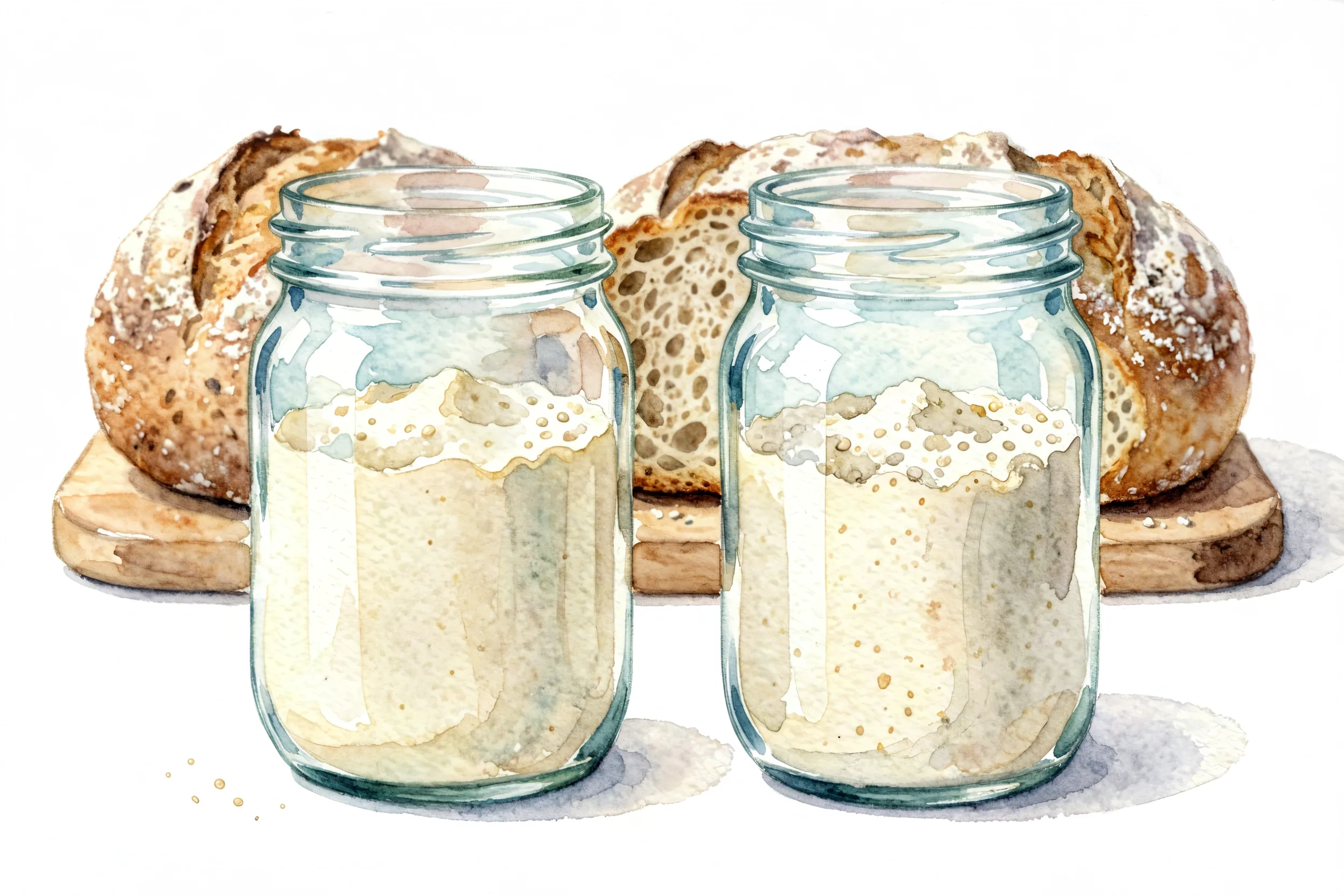
Sourdough Levain vs Starter: What Is the Difference?
📖 6 min read · Updated July 2026
By SourdoughCalc Team
If you have read more than two sourdough recipes, you have probably seen the words starter and levain used interchangeably. They are not the same thing. The starter is the permanent culture you keep alive in your fridge. The levain is what you build from that starter to bake a specific loaf. Mixing them up leads to confusion about ratios, timing, and what to do with your discard. This guide clears it up.
What Is a Sourdough Starter?
Your starter (also called mother dough or original) is the long-lived mixture of flour and water that you maintain indefinitely. It lives in a jar in your fridge, and you feed it regularly to keep it active. The starter is a stable ecosystem of wild yeast and lactic acid bacteria that has adapted to your specific flour, water, and environment.
A typical home baker might have a starter that is months or years old. Every time you feed it, you discard some and add fresh flour and water. The discarded portion is your discard (see our discard recipes).
Think of the starter as the source. It is not what you bake with directly. It is what you build other things from.
What Is a Levain?
A levain (French for leaven) is a portion of your starter that you refresh and build up specifically to bake one loaf (or one batch). You mix some of your starter with fresh flour and water, let it ferment until it is at peak activity, and then mix it into your final dough.
Unlike the starter, the levain is short-lived. Once you use it in a dough, it is gone. You do not try to keep it going. Next time you want to bake, you build a fresh levain from your starter.
The levain is what actually leavens your bread. The starter is what you keep alive; the levain is what you use.
Why Does the Difference Matter?
Treating the starter and levain as the same thing causes three common problems:
- Wrong ratios. If you think of the levain as the starter, you might use 100% of the starter in your dough, leaving nothing to maintain. Or you might use 10% of the starter, which is too little to leaven bread in a reasonable time.
- Bad timing. The starter lives in the fridge and is mildly active. The levain is built to peak activity in 4-8 hours. If you use the starter straight, your dough will ferment unpredictably.
- Discard confusion. When people say discard, they usually mean the part of the starter you throw away before feeding. But you can also use starter discard to build a levain, eliminating waste.
How Do Starter and Levain Work Together?
The relationship in three steps:
1. Maintain the starter. Keep it in the fridge. Feed it once a week if you bake weekly, or once a month if you bake less. Discard half before each feed, then add equal parts flour and water.
2. Build a levain when you want to bake. Pull a small amount of starter (usually 1-2 tablespoons) and mix it with fresh flour and water in a clean jar. Let it sit at room temperature for 4-8 hours until it has doubled and is at peak activity (the highest point of rise, just before it starts to fall).
3. Mix the levain into your dough. Use the entire levain in your final dough. There is nothing left to keep. Next bake, you build another levain from the starter.
What Levain Ratio Should You Use?
The ratio of starter to flour to water in your levain affects how fast it peaks. Use this as a starting point:
- 1:1:1 (by weight, starter:flour:water) peaks in 4-6 hours at room temp. Good for same-day bakes.
- 1:2:2 peaks in 6-8 hours. Use when you want to bake in the evening after a morning build.
- 1:3:3 peaks in 8-12 hours. Best for overnight levain at room temperature.
- 1:5:5 or 1:10:10 peaks in 12-24 hours. Use for a cold levain in the fridge.
A higher ratio (more flour and water, less starter) takes longer to peak. This gives you more flexibility to build the levain at night and bake the next morning.
How Do You Build a Levain?
For a typical 500g flour recipe (one loaf), build this levain:
- Starter from fridge: 50g (about 2 tablespoons)
- Flour: 100g
- Water: 100g
Mix in a clean jar, cover loosely, and leave at room temperature (75-78F). Wait 4-6 hours. The levain is ready when it has at least doubled in volume, has lots of bubbles on top and sides, and smells pleasantly tangy (not harsh or vinegary). It should be at its peak rise, just starting to dome and slowly fall back at the edges.
If you use the levain before it peaks, your dough will be under-leavened. If you wait too long after peak, the yeast has exhausted its food and your dough will be sluggish. Aim for peak to peak-minus-30-minutes.
FAQ
Can I use my starter straight from the fridge without building a levain?
Technically yes, but it is unpredictable. A cold starter is sluggish. A recently fed levain is at peak activity and will leaven your dough faster and more reliably.
How much starter do I need to keep to build a levain?
About 30-50g is enough. Keep a small amount (a few tablespoons) in a jar, feed it weekly, and use a bit of it to build your levain when you want to bake.
Can I use the same jar for starter and levain?
No. Keep them separate. The starter should be the stable culture you always come back to. The levain is a one-time build. Mixing containers can lead to confused ferments and inconsistent results.
What if my levain does not double?
Your starter may be too cold, too old, or underfed. Feed your starter 12 hours before building the levain, then build a new one. If it still does not rise, your starter may be dead and you need to start a new one.
Which Should You Use for Baking?
Starter: what you keep. Levain: what you build. The starter is your permanent culture; the levain is the temporary, peak-active portion you mix into your dough. Once you keep them straight in your head, sourdough baking becomes much more predictable.
Use our free hydration calculator to scale any recipe to your loaf size, and our discard recipes to use up what you remove when feeding your starter.
References
- Reinhart, P. (2010). The Bread Baker's Apprentice. Ten Speed Press.
- Forkish, K. (2012). Flour Water Salt Yeast. Chronicle Books.
- Suas, M. (2009). Advanced Bread and Pastry. Delmar Cengage Learning.
- Hamelman, J. (2004). Bread: A Baker's Book of Techniques and Recipes. John Wiley and Sons.
- Leo, M. Sourdough Starter Guide. The Perfect Loaf. Accessed August 2026.
- King Arthur Baking. Sourdough Starter Recipe. Accessed August 2026.