How to Store Sourdough Bread (5 Methods That Actually Work) [2026] for Days
📖 8 min read · Updated July 2026
By SourdoughCalc Team
You spent 24 hours baking a beautiful sourdough loaf. Now what? Store it wrong and you will eat stale bread tomorrow. Store it right and the same loaf tastes great on day four. This guide covers every storage scenario: room temperature, refrigerator, freezer, and how to store the dough itself before you bake.
What Is the Best Way to Store Sourdough Bread?
Cut loaf: store at room temperature in a cotton bag or paper bag for 2-3 days. Never in plastic unless you want a soft, gummy crust.
Whole loaf, long-term: freeze sliced for up to 3 months. Toast directly from frozen.
Unbaked dough: refrigerate for up to 5 days, or freeze for up to 1 month.
That is the 30-second version. Below is the why and the how for each scenario.
Why Does Sourdough Go Stale?
Bread goes stale through a process called starch retrogradation. When bread cools, the gelatinized starch molecules in the crumb start to re-crystallize and squeeze out moisture. This is what makes day-old bread feel hard and dry.
Moisture loss also plays a role. A naked loaf on a counter loses moisture to the air and dries out within hours. To slow staling, you need to control moisture and air exposure.
Sourdough has one advantage over commercial bread: the lactic and acetic acids slow retrogradation. This is why sourdough stays edible longer than supermarket bread, even under the same storage conditions.
How Should You Store Sourdough Bread?
1. Room Temperature, Cut Side Down (Best for 1-3 Days)
Best for: a loaf you will eat within 3 days.
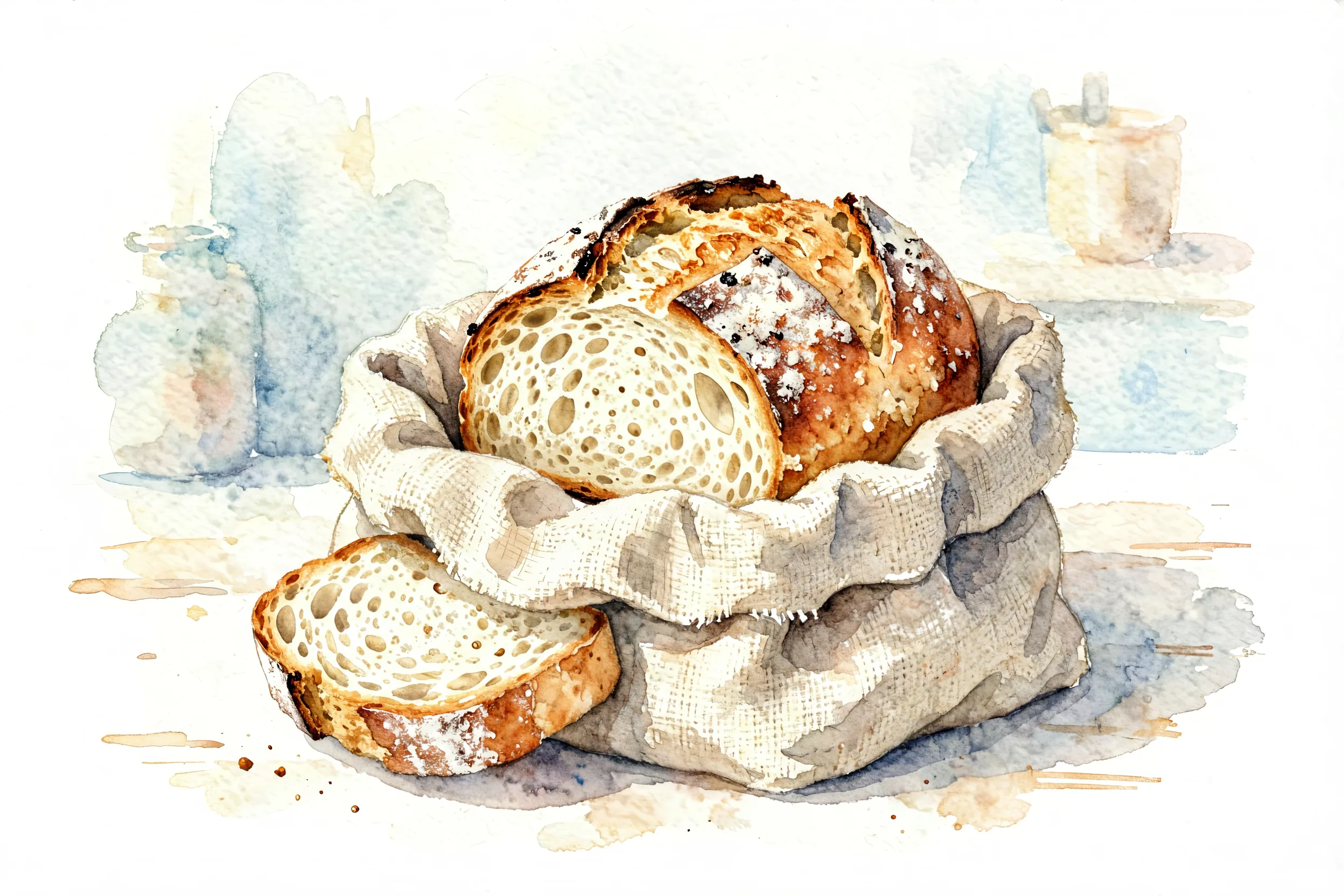
Method: Stand the loaf cut-side down on a wooden board, or in a cotton bread bag, paper bag, or pillowcase. Avoid plastic: it traps moisture and makes the crust soft and the crumb gummy.
Why cut-side down: the exposed crumb is the most vulnerable surface. Putting it down blocks air contact and slows staling at the cut face by 30-50%.
Expected life: 2-3 days at room temperature (72F/22C). In summer or if your kitchen runs warm, count on 1-2 days.
2. Linen or Cotton Bread Bag (Best for Crust)
A linen or cotton bag breathes just enough to keep the crust crisp while preventing excessive moisture loss. These are sold as "bread bags" or "sourdough bags" online for $10-20.
A clean cotton pillowcase works in a pinch. Cut a 12x16 inch piece, fold over the loaf, and tuck the ends underneath.
3. Bread Box (Best Long-Term at Room Temp)
A wooden bread box is the traditional solution. The wood absorbs excess moisture on humid days and releases it on dry days, creating a stable microclimate. A good bread box keeps a sourdough loaf fresh for 4-5 days.
Avoid ceramic or plastic boxes. Ceramic is too airtight (sourdough crust turns soft). Plastic is the same problem as a plastic bag.
4. Refrigerator (Not Recommended)
Do not refrigerate sourdough bread. The cold environment accelerates starch retrogradation. A refrigerated loaf goes stale faster than one left on the counter. This is one of the most counterintuitive facts in bread science, but it has been demonstrated in multiple controlled studies.
The exception: if your kitchen is above 80F (27C) and humid, the counter may cause mold before staling. In that case, slice and freeze. Do not refrigerate whole loaves.
5. Freezer (Best for 1-3 Months)
Best for: long-term storage when you cannot eat the bread in 3-4 days.
Method: Slice the loaf (you can refreeze whole but slicing lets you toast individual pieces). Wrap tightly in plastic wrap or aluminum foil, then place in a freezer bag with the air pressed out.
Why slice first: frozen bread is hard to slice cleanly. Pre-slicing also lets you take out only what you need.
To use: toast directly from frozen. Do not thaw first: thawed frozen bread loses its crust and becomes gummy. The toaster or oven re-crisps the crust while warming the crumb.
Expected life: up to 3 months in the freezer. Beyond that, the bread picks up off-flavors and the texture degrades.
6. Storing Dough Before Baking
Sometimes you shape dough and want to bake it the next day. Or you want to bake one loaf today and one tomorrow from the same batch.
Refrigerator (up to 5 days): place shaped dough in a lightly oiled container, cover, and refrigerate. The cold slows fermentation but does not stop it. Take it out 2-3 hours before baking so it warms up and finishes proofing.
Freezer (up to 1 month): shape the dough, wrap tightly in plastic, and freeze on a baking sheet first (so it holds its shape), then transfer to a freezer bag. Thaw in the refrigerator overnight, then warm at room temperature 2-3 hours before baking.
Tip: frozen shaped dough bakes almost identically to fresh. The crumb is slightly tighter, but most people cannot tell the difference.
Storage Methods at a Glance
Five common storage methods, ranked by best use case. Pick one based on how long you need to keep the bread fresh.
| Method | Freshness | Crust | Best For | Avoid If |
|---|---|---|---|---|
| Cotton Bread Bag | 2-3 days | Stays crisp | Daily-use loaves | Storing more than 3 days |
| Bread Box | 2-3 days | Stays crisp | Counter storage, displays | Limited counter space |
| Paper Bag | 1-2 days | Very crisp | Maximum crust retention | Long-term storage |
| Freezer (sliced) | 1-3 months | Re-crisps when toasted | Long-term, ready-to-toast | Need crust immediately |
| Refrigerator | Speeds up staleness | Goes soft fast | Not recommended | Almost everything - avoid |
What Storage Mistakes Ruin Sourdough?
Slicing before you need it
Every cut surface is exposed crumb that loses moisture fast. Leave the loaf whole until you need it. Slice as you go.
Storing in the bread machine pan
If you baked in a Dutch oven, transfer the loaf to a wooden board or bread bag as soon as it cools. The cast iron retains moisture that softens the crust.
Wrapping in foil at room temperature
Aluminum foil traps moisture. The crust will soften within hours. Use foil only for freezing, where it prevents freezer burn.
Storing with butter or spreads already on
Once you cut and butter a slice, eat it. Do not put it back. The butter oxidizes and turns rancid quickly, especially at room temperature.
How Long Does Sourdough Bread Last?
Whole loaf, room temperature: cotton bag, 2-3 days
Whole loaf, bread box: wooden box, 4-5 days
Sliced loaf, room temp: paper bag, 1-2 days
Whole loaf, freezer: plastic wrap + bag, up to 3 months
Sliced loaf, freezer: individual slices in bag, up to 3 months
Shaped dough, fridge: oiled container, up to 5 days
Shaped dough, freezer: wrapped, up to 1 month
FAQ
Why does my crust go soft overnight?
The crust absorbs moisture from the air and from the bread itself as it cools. This is normal. To re-crisp, put the loaf in a 400F oven for 5 minutes. The crust will come back.
Can I store different loaves together?
Yes, but be aware that flavors transfer. A rye loaf stored next to a white loaf will make the white loaf taste slightly of rye. Not usually a problem for home bakers.
Does sourdough last longer than commercial bread?
Yes. The acids in sourdough slow starch retrogradation and inhibit mold. A typical sourdough loaf stays fresh 2-3 days longer than an equivalent commercial loaf under the same conditions.
Should I wrap in plastic if I live in a humid climate?
No. Even in humid climates, plastic makes the crust soft and the crumb gummy. Use a paper bag or freeze instead. Paper absorbs excess moisture while still allowing some airflow.
What Is the One Rule for Storing Sourdough?
For most home bakers: keep it at room temperature in a cotton bag or bread box for 2-3 days, then freeze the rest sliced. That single rule will keep your sourdough loaf at peak quality from start to finish.
Skip the refrigerator. Slice only what you need. Toast from frozen for the best results.
References
- Reinhart, P. (2010). The Bread Baker's Apprentice: Mastering the Art of Extraordinary Bread. Ten Speed Press.
- Forkish, K. (2012). Flour Water Salt Yeast: The Fundamentals of Artisan Bread and Pizza. Chronicle Books.
- Calvel, R. (2001). The Taste of Bread. Aspen Publishers.
- Leo, M. Beginner Sourdough Bread. The Perfect Loaf. Accessed August 2026.
- King Arthur Baking. Sourdough Guide. Accessed August 2026.
- Breadtopia. Whole Grain Sourdough Bread. Accessed August 2026.
The storage recommendations in this article are based on standard bread science and home-baking practice as documented in these sources. Staling behavior varies by flour type, ambient humidity, and crumb density.