Best Sourdough Starter Kit for Beginners (2026): What You Actually Need
📖 7 min read · Updated August 2026
By SourdoughCalc Team
Marketing copy aside, a sourdough starter is flour and water in a jar. That is the whole recipe. So when a $60 starter kit arrives with a special jar, a wooden stirrer, a recipe card, and a marking band, most of it is decoration.
We have been baking sourdough for years and have built starter in everything from a half-pint deli container to a proper European-style crock. Here is what we think is actually worth buying in 2026, and what you can safely skip.
The 4 Things Worth Buying
Anything beyond these four is optional. Most starter kits on Amazon try to upsell you on thermometers, marking bands, and specialty cloths. None of those change the outcome of your starter. The four below do.
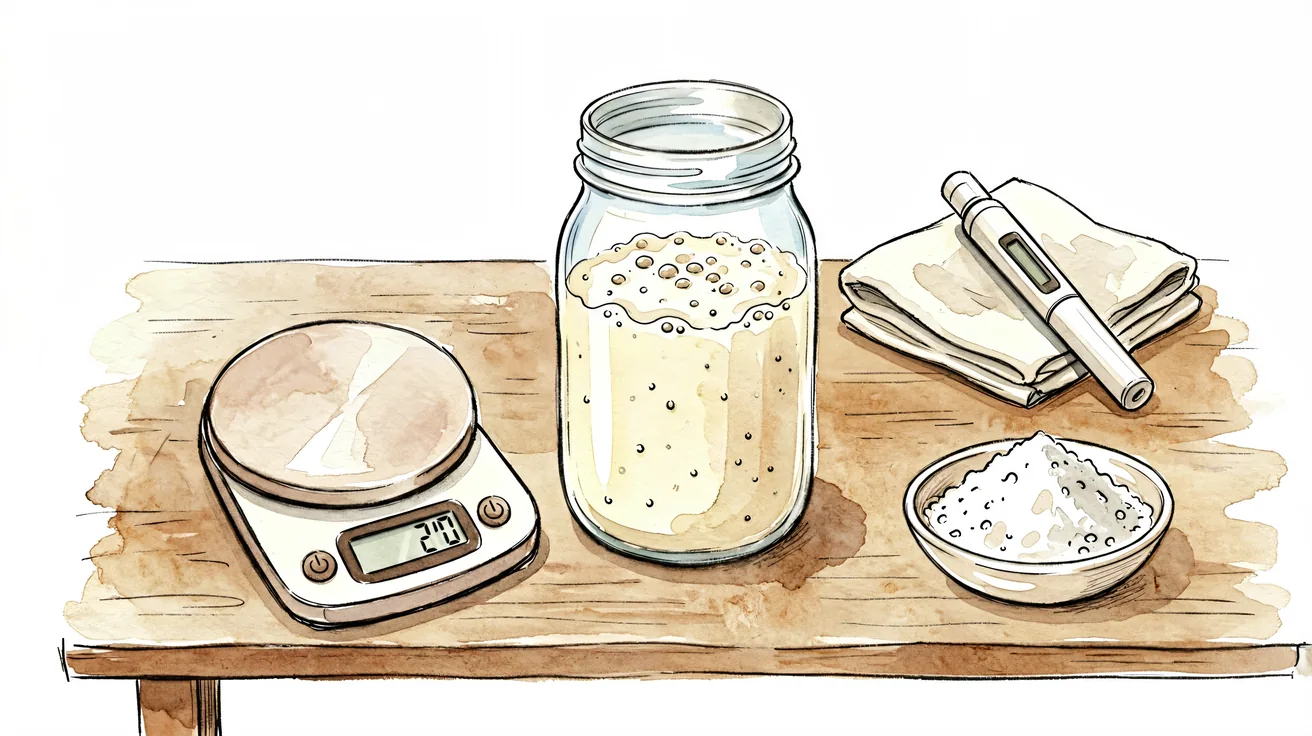
1. A 1-quart (or 1-liter) glass jar with a lid
Weck or Ball mason jar. A straight-sided jar with a wide mouth is the standard. The wide mouth makes stirring and feeding easy. The glass is non-reactive. Most home bakers use a 1-quart (about 1-liter) jar for the first 6 months, then size up if they are maintaining large backups.
Top pick: Weck 1-liter Mold Jars (set of 12) on Amazon
Price: $30 to $40. The classic European sourdough jar. Tapered glass, easy to clean, lasts forever. Comes with glass lids and rubber gaskets.
2. A digital kitchen scale that reads 1 gram
This is the single most useful tool in your entire sourdough setup, not just for starter. Every sourdough recipe is written in baker\'s percentages, which requires weighing flour and water. A $15 kitchen scale that reads 1-gram increments is enough. Without one, you cannot make consistent bread. With one, you can.
Top pick: Digital Kitchen Scale 1g Increments on Amazon
Price: $15 to $30. Look for: 1g resolution (not 5g), tare function, auto-off. Any brand works; OXO, Etekcity, Amazon Basics are all fine.
3. A loose-weave cloth or rubber band to cover the jar
Starter needs to breathe. A tight lid will build up CO2 and slow yeast. The simplest cover is a paper towel + rubber band. A loose-weave linen cloth works too. Most people have these in their kitchen already.
You probably already own this. If you want to buy a dedicated cover, a pack of cotton cheesecloth from Amazon is under $5.
4. A digital thermometer (water temperature)
You will read about controlling dough temperature constantly. The best way to do that is to know the water temperature you are pouring in. A $10 instant-read thermometer takes 5 seconds and removes one of the biggest sourdough variables.
Top pick: Instant-Read Digital Cooking Thermometer on Amazon
Price: $10 to $20. Waterproof, reads in 3 seconds, accurate to +/- 1 degree. The cheap ones work fine.
The 3 Things to Skip
These are the items that sourdough starter kits love to bundle because they look artisan on the box. They do not change the outcome of your starter.
Skip: Specialty starter cloths and filters
$15 linen cloths with drawstring tops. They look beautiful. A paper towel held with a rubber band does the same job. Save the $15.
Skip: Marking bands and elastic rings
The rubber band you put around the jar to mark the starter level. Use a rubber band you already have. The starter grows the same way.
Skip: Starter flour packets
Most kits ship a small bag of "starter flour." You can ignore it. Use any unbleached all-purpose or bread flour. King Arthur bread flour ($7/5 lb at most grocery stores) is the standard reference. The starter flour in kits is usually cheaper flour rebranded.
The Total Real Cost
Essentials (the 4 above): about $60 to $100, depending on scale and thermometer choice. Most home bakers already own a kitchen scale, so the realistic out-of-pocket is $30 to $50 (jar + thermometer + cloth).
Pre-built "starter kit" on Amazon: $35 to $80. Most include the essentials plus the 3 things to skip. You can buy the essentials yourself for less and skip the extras.
Premium kits (King Arthur, Breadtopia, etc.): $60 to $120. Higher price for branding, a recipe card, and a fancier jar. Functionally identical to the $30 essentials.
Building Starter Day 1: Quick Reference
Once you have the jar and flour, building a starter takes 5 minutes of actual work spread over 5 to 7 days. The recipe:
Day 1: 50 g bread flour + 50 g water in jar. Stir, cover loosely.
Days 2 to 5: discard half, add 50 g flour + 50 g water. Stir once a day.
Days 5 to 7: starter should rise and fall predictably. It is ready to use. Use our hydration calculator to make your first loaf.
For a deeper walkthrough, see our 7-day starter guide.
Sourdough Starter Kit FAQ
Do I really need a special sourdough jar?
No. Any glass jar with a wide mouth and at least 1-quart capacity works. The classic Weck jar is a preference, not a requirement.
Can I make a starter without a thermometer?
Yes, but you will have inconsistent results in different seasons. A $10 thermometer removes one of the biggest variables in sourdough. Worth it for the first 6 months of baking.
Are King Arthur or Breadtopia starter kits worth the premium?
Functionally, no. You are paying for branding and a recipe card. The contents are equivalent to a $30 essentials build. The only reason to buy a branded kit is if you want the gift-ready presentation.
What if my starter smells like vinegar?
It needs more frequent feeding or warmer temperature. See our 7-day starter guide for troubleshooting.
Sources
- King Arthur: Building a Sourdough Starter
- The Perfect Loaf: Sourdough Guides
- Tartine Bread by Chad Robertson — starter chapter