How to Score Sourdough Bread: Patterns, Tools, and When to Cut
📖 7 min read · Updated August 2026
By SourdoughCalc Team
Scoring is the final artistic step in sourdough baking. The slashes you cut before loading the loaf into the oven are not decorative — they control where the bread expands. A loaf scored correctly will open up dramatically at the cut during oven spring. A loaf scored wrong (or not at all) will tear randomly at weak spots in the surface.
The good news: scoring is a learnable skill that takes 10 minutes to grasp and a lifetime to perfect. The single most important thing is not the pattern you choose. It is timing.
What Scoring Actually Does
When the dough goes into a hot oven, the gas inside expands rapidly. That expansion has to go somewhere. A loaf that is not scored expands at the weakest point of its surface, which is almost never where you want it. A scored loaf expands along the cut, because the cut is now the weakest point.
This is why bakers say "scoring controls the bloom." A clean, deliberate cut produces a dramatic ear (the section that lifts up). A shallow or hesitant cut produces a partial opening. A cut that is too deep tears wide and deflates. A cut that comes too late (after the dough has already set) only cracks the surface without opening.
When to Score: Timing Is Everything
Score right before loading the dough into the oven. Not 5 minutes before. Not 30 minutes before. Right before.
If the dough has had a final proof at room temperature (60 to 90 minutes), it is ready to score when:
- It has grown about 50 to 75 percent from its post-shape size
- It jiggles slightly when you shake the banneton
- Your finger pressed gently into the surface leaves an indent that springs back slowly
If the dough has had a long cold retard (12 to 48 hours in the fridge), it can be scored straight from the fridge. Cold dough is firmer and the cuts will be sharper. Let it sit at room temperature for 10 to 15 minutes after scoring to take the chill off before loading into the oven.
If the dough is over-proofed (very jiggly, indent does not spring back), it will deflate under the lame no matter how good your cut is. The fix is not better scoring. The fix is shorter proof next time.
The Tools You Need
1. A lame. A lame is a razor-blade holder designed for scoring. Standard double-edged razor blades work for most loaves. Curved blades give a wider ear; straight blades give a tighter cut. The lame is the only specialized tool you absolutely need.
2. A sharp blade. Replace the blade every 5 to 10 bakes. A dull blade drags rather than cuts, leaving ragged edges. The bread will still expand, but the cut will look torn rather than clean.
3. Rice flour or all-purpose flour for dusting. A light dusting on the dough surface before scoring gives the blade something to grip and prevents sticking. Skip this if you are doing a hydration above 80 percent, where the surface is already wet.
You do not need a special cutter for home baking. A sharp paring knife works, though a lame gives better control. What you do not want: scissors, dull knives, or serrated bread knives. All of these drag.
Five Classic Scoring Patterns
The pattern itself matters less than the depth, angle, and timing. Pick one that fits the shape of your loaf.
1. Single Slash (Boule or Batard)
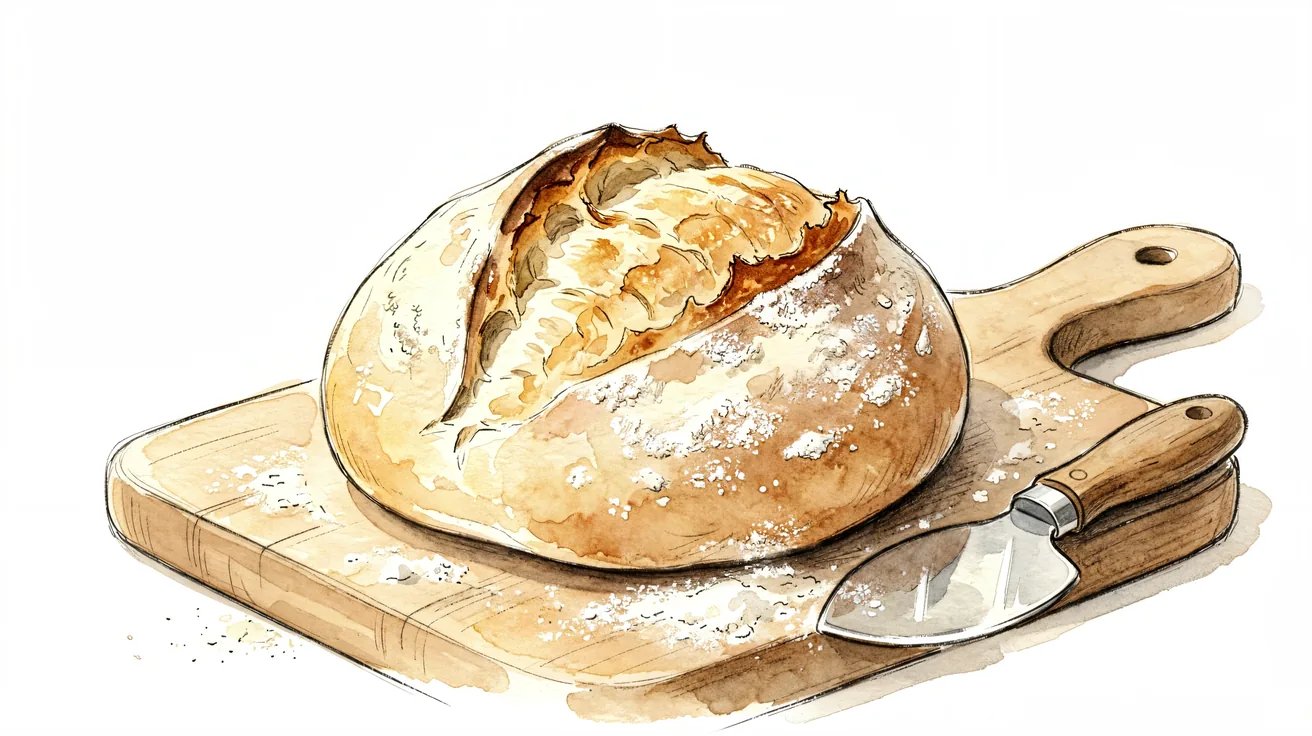
One cut, 30 to 45 degrees off vertical, about 1/4 inch deep, slightly curved. The most common pattern. Produces a dramatic ear on a round loaf. Length should be about 70 percent of the loaf diameter.
2. Cross (Boule)
Two cuts, perpendicular, each 1/4 inch deep, intersecting at the center. Produces four quadrants that each open up. The classic French country loaf look.
3. Wheat Stalk (Boule or Batard)
A long central cut, with shorter diagonal cuts on each side, like a stalk of wheat. Visual impact, but the side cuts can collapse if too shallow. Best for confident scoremakers.
4. Spiral (Round)
A continuous spiral from the center outward, about 1/4 inch deep. Used for round loaves where you want the bloom to fan out evenly. Easier than it looks; takes one continuous motion.
5. Three-Cut Leaf (Batard)
Three parallel diagonal cuts, like a leaf shape. Good for batards (oval loaves) where a single slash would be too short. Each cut opens independently.
Common Mistakes
1. Too shallow. The cut should be 1/4 inch deep. A 1/8 inch cut barely opens during oven spring. Err on the side of deeper rather than shallower.
2. Too late. If the dough has set (over-proofed, or just sat too long after coming out of the fridge), the cut will crack without opening. Cut earlier next time.
3. Dragging the blade. Use one quick confident motion. A hesitant cut leaves ragged edges. If you hesitate, you are probably cutting too slowly.
4. Cutting into the seam. If you shape the dough with a seam (most batards do), make sure your cut does not run along the seam. The seam is already the weakest point; scoring it will not add anything.
Top Picks
Best Lame: Bread Lame with Replacement Blades on Amazon
Price: $10 to $20. Comes with 5 to 10 spare blades, fits comfortably in hand. The standard for home bakers.
Best Curved Blade Upgrade: Curved Blade Lame on Amazon
Price: $12 to $25. Curved blade gives a wider ear, the classic bakery look. Worth upgrading after you are comfortable with the standard straight lame.
As an Amazon Associate, we earn from qualifying purchases. Prices stay the same for you.
Sourdough Scoring FAQ
How deep should I score sourdough?
About 1/4 inch deep, or roughly 5 millimeters. Shallow cuts do not open dramatically. Deeper cuts open wide and can deflate. Err slightly deeper than you think is right.
Can I score without a lame?
Yes. A sharp paring knife or a fresh razor blade held in pliers works. The lame just makes the handle safer and the angle easier to control.
Should I score before or after putting the dough in the oven?
Always score before. The scoring opens the dough at the weakest point, which is exactly what you want during the rapid expansion of oven spring. Scoring after the bread is in the oven does nothing.
What is a "bloomer cut" vs. "ear cut"?
Both terms describe how a slash cut opens during baking. An "ear" is a single dramatic lift; a "bloomer" or "wheat" cut produces multiple smaller lifts. The two are mostly interchangeable; bakers use different terms to describe the visual effect of their chosen pattern.
Sources
- King Arthur: Shaping and Scoring Sourdough
- The Perfect Loaf: Shaping and Scoring
- Tartine Bread by Chad Robertson — scoring chapter
- How to Store Sourdough Bread — keep your scored loaf fresh for days