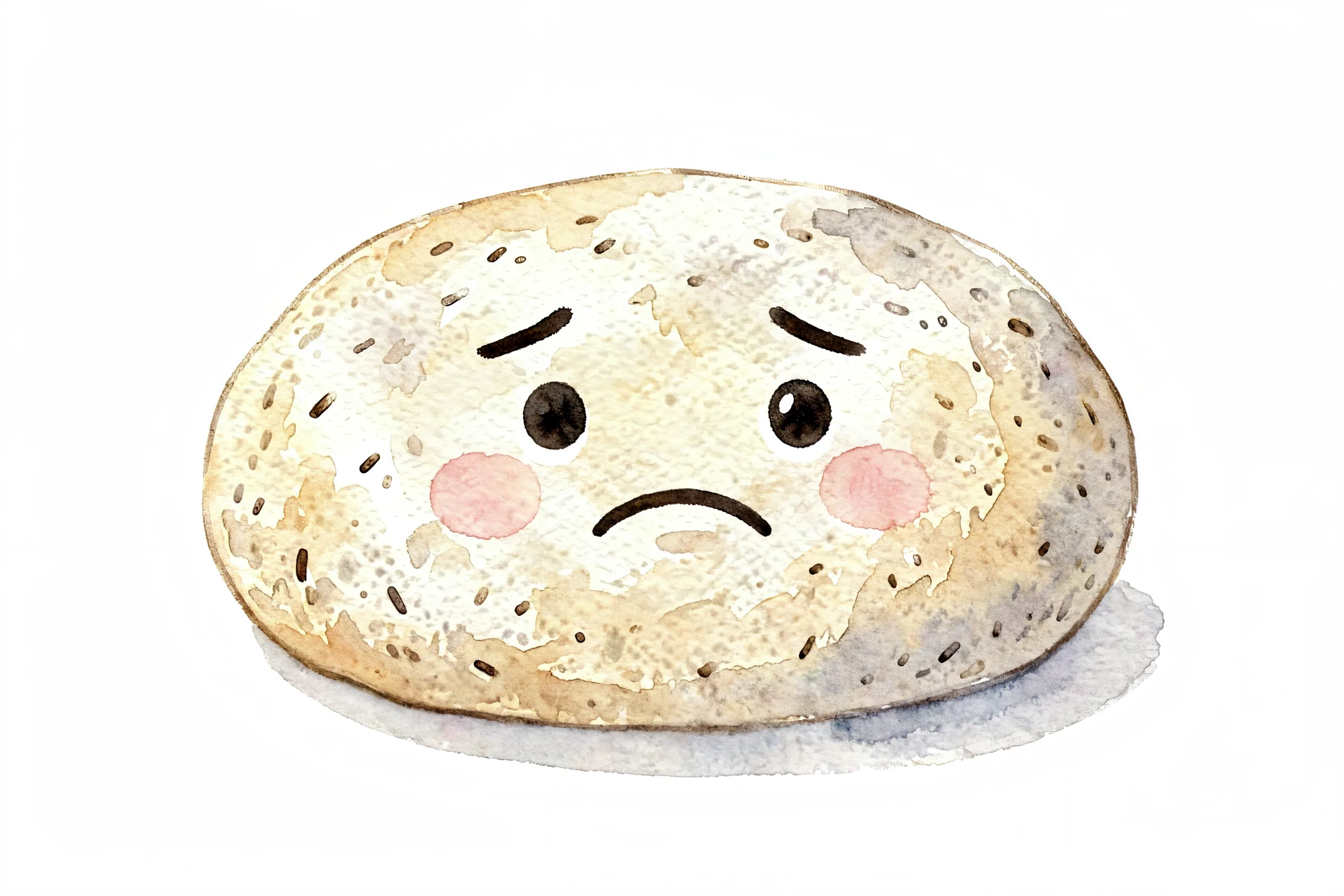
Why Your Sourdough Did Not Rise: 12 Causes and Fixes
📖 10 min read · Updated July 2026
By SourdoughCalc Team
Sourdough is supposed to rise. When it does not, there is always a reason. Here are the 12 most common causes, organized by when they happen in the bake, with specific fixes for each.
How to Diagnose a Loaf That Did Not Rise
Match your loaf to the symptom below. The fastest fix is usually the one that matches what you actually see, not what the recipe says.
| Symptom | Most likely cause | Fastest fix |
|---|---|---|
| Flat and wide | Too much water or weak shaping | Lower hydration to 70-72% and build more tension |
| Dense and heavy | Under-bulk or weak flour | Extend bulk until the dough rises 50-75% |
| Gummy crumb | Cut too early or under-baked | Bake until the center reaches 205-210°F |
| Vinegar smell | Over-fermented or too much starter | Shorten bulk and use 15-20% ripe starter |
| Pale crust | Oven too cool or no steam | Preheat to 500°F and add steam |
| Explosive oven spring | Under-proofed final proof | Wait until the poke test leaves a slow indent |
1. The Starter is Young or Weak
Symptom: Dough barely rises at all. The starter itself takes 12+ hours to peak.Fix: Use a starter that is at least 2 weeks old and reliably doubles in 4-6 hours after feeding. If your starter is slow, give it more time. Or feed it more often (every 4-6 hours) for a few days to strengthen it.
Building your first starter? Follow our 7-day sourdough starter guide.
2. Cold Kitchen
Symptom: Dough barely rises even with a strong starter. Bulk takes 8+ hours.Fix: Find a warmer spot. On top of the fridge, inside the oven with just the light on, in a cooler bag with a warm water bottle. Target 75-80°F for bulk.
3. Too Much Salt
Symptom: Slow rise, dense crumb. Salt inhibits yeast.Fix: Use 1.8-2% salt by baker's percentage. Re-measure with a scale. Salt volumes vary wildly by type.
4. Too Much Starter Inhibits
Symptom: Dough rises fast initially but collapses. Too much starter over-acidifies.Fix: Use 15-20% ripe starter. More than 25% and the dough becomes acidic and unstable.
5. Not Enough Starter
Symptom: Slow rise, weak oven spring.Fix: Use at least 15% ripe starter. Below 10% and fermentation is too slow.
6. Flour is Too Weak
Symptom: Dough spreads flat. Crumb is tight. Oven spring is weak.Fix: Use bread flour (12-14% protein) or blend with vital wheat gluten. Cake flour and pastry flour do not have enough gluten.
Need help choosing? Read our complete flour guide.
7. Too Much Water
Symptom: Dough collapses, spreads during proof.Fix: Lower hydration by 5%. Most beginners do better at 70-72% hydration than 75%+. Use our calculator to track accurately.
The full sourdough hydration guide explains why water level matters so much.
8. Bulk Fermentation Too Short
Symptom: Dense crumb, pale crust, bland flavor.Fix: Bulk for 4-6 hours at 70-75°F, or until 50-75% rise with domed top. Time alone is unreliable; watch the dough.
Our bulk fermentation guide covers timing, temperature, and visual cues in detail.
9. Over-Fermented
Symptom: Dough collapses when shaped. Strong vinegar smell. Flat loaf.Fix: Cut bulk time by 30-60 minutes. Aim for 50% rise, not 100% doubled.
10. Weak Shaping
Symptom: Spreads flat in oven. No oven spring.Fix: Build more surface tension. Use a bench scraper. Drag the dough rather than folding. See our boule shaping guide for three methods.
11. Under-Proofed Final Proof
Symptom: Dense crumb, explosive oven spring, tears in the crust.Fix: Let the final proof go longer. The poke test: poke the dough with a floured finger. If it springs back slowly and leaves a slight indent, it is ready. If it springs back quickly, it is under-proofed.
12. Oven Too Cool
Symptom: Pale, soft crust. No oven spring.Fix: Preheat to 500°F for at least 45 minutes. Use an oven thermometer. Most home ovens are 25-50°F off. A Dutch oven or pizza steel helps a lot.
The Quick Diagnostic
Flat loaf: under-proofed final proof OR over-bulk OR too much water.
Dense crumb: under-bulk OR weak flour.
Vinegar taste: over-bulk OR too much starter.
Pale crust: oven too cool OR not enough steam.
Use our hydration calculator to dial in the right hydration for your flour and conditions. The most common cause of flat/dense bread is a hydration that is too high for your flour strength.
Sourdough Did Not Rise FAQ
Why is my sourdough flat but not dense?
A flat, wide loaf usually means the dough lost structure before baking: too much water, weak shaping, or over-fermentation. Lower the hydration slightly and build more surface tension during shaping.
Can I save a dough that did not rise?
Sometimes. If the dough is under-fermented, move it somewhere warmer and wait for a 50-75% rise. If it is over-fermented, reshape it quickly and proof it in the fridge before baking.
How long should sourdough take to rise?
At 70-75°F, expect 4-6 hours of bulk fermentation and a final proof of 1-4 hours at room temperature or 8-16 hours in the fridge. Time depends on starter strength and dough temperature.
Related Reading
- How to Make a Sourdough Starter from Scratch
- Sourdough Bulk Fermentation: Timing and Temperature
- Sourdough Hydration: The Complete Beginner's Guide
- How to Shape a Sourdough Boule